
From tendering to building management: how the Pro4all portfolio fits into your construction process
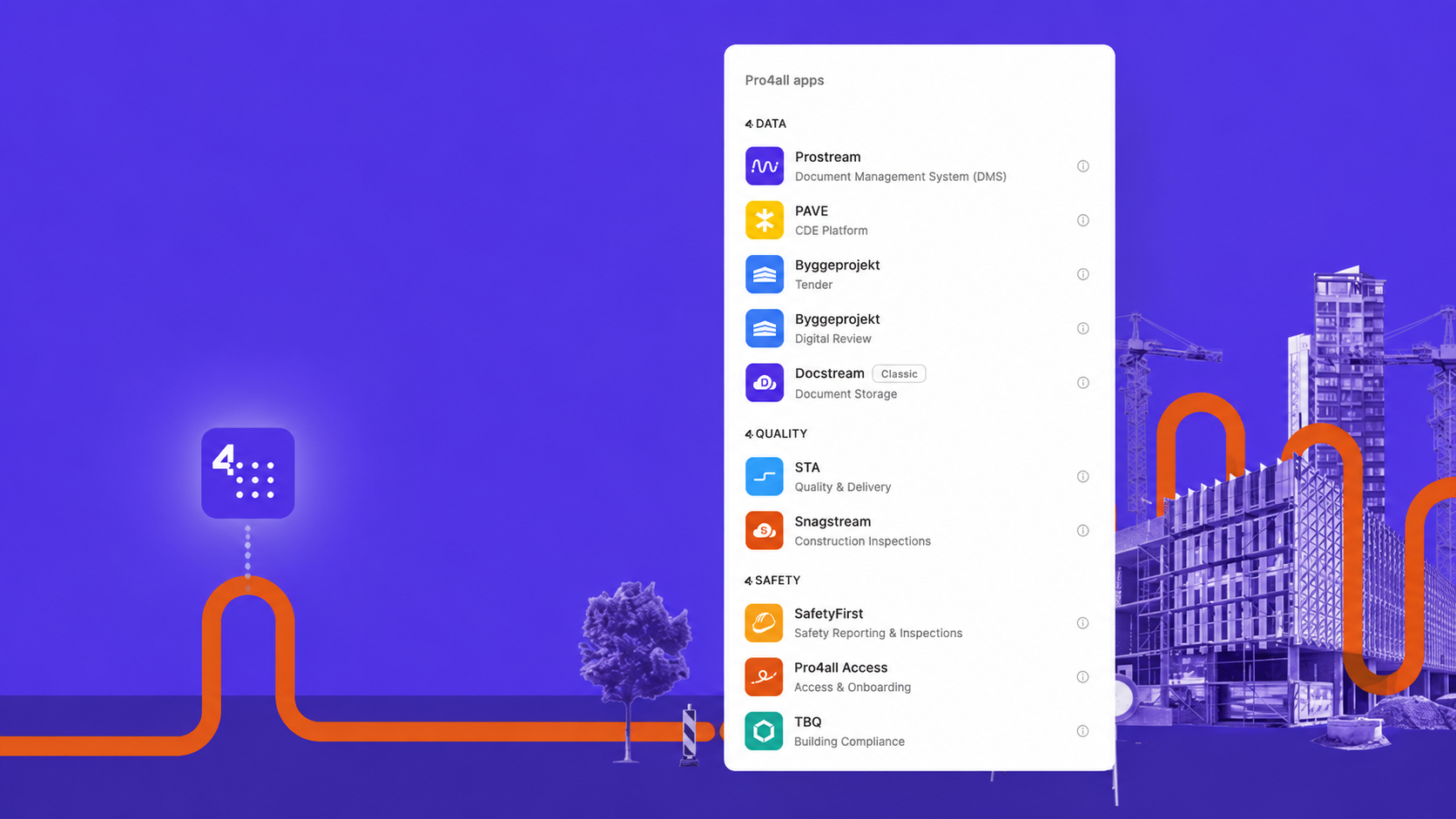
With the release of the Pro4all App Launcher on the 3rd of September, it is now possible to navigate to every Pro4all application available to you directly from your pro4all platform!
A construction project moves through several phases. First, partners and plans are selected. Teams then need to work with the right information, people must enter the construction site safely and findings need to be recorded properly. After handover, the focus shifts to warranties, building safety and compliance.
Each Pro4all application solves a specific problem in that process. This guide shows where each product fits and how the different solutions relate to one another.
This guide covers the complete European Pro4all portfolio. Not every product is currently available in every country.
Phase 1: Tendering and design review
The first controlled exchange of information takes place before construction begins. Tender documents must reach the right parties, questions and responses need to remain traceable and design decisions must be easy to retrieve later.
Byggeprojekt Tender: a controlled tender process
Tender supports the tender process from publication to award. Documents, responsibilities, questions, deadlines and bids are managed in one structured environment.
This helps tender teams keep the process transparent and gives all participating parties access to the correct information. It also creates a traceable record of what was issued, when information was made available and how decisions were reached.
Byggeprojekt Digital Review: structured design approval
Digital Review organises the review and formal approval of drawings and documents. Reviewers can add markups and comments to the relevant document, while tasks, deadlines, versions and changes remain visible in one place.
Instead of working with forwarded PDFs, separate spreadsheets and disconnected email chains, the project team reviews the same information in a controlled process.
Together, Tender and Digital Review create a traceable information and decision-making process that can form the basis for the next project phase.
Tender and Digital Review are currently available in Denmark 🇩🇰
Phase 2: Organising project information and BIM
Tendering and design review create the information basis for construction. Drawings, documents, models and changes need a fixed, controlled home. The right route depends on the existing environment and the complexity of the project.
Prostream DMS: modern document management
Prostream brings documents, versions, tasks and project communication together in one central environment.
Project teams can find and share the latest information, link tasks to documents and maintain control over changes. This reduces the risk of people working from an outdated drawing or losing information across email, chat and separate file storage.
Prostream forms an information foundation, which processes such as access, safety, quality registration and handover rely on.
Docstream: document storage and sharing
Docstream is the fully operational predecessor to Prostream DMS. It provides version-controlled document storage and file sharing for project teams.
Its functionality includes workflow management, digital feedback, reprographics and support for files and models that are too large to exchange by email.
PAVE: the CDE route for complex projects
PAVE is designed for complex construction projects with extensive BIM data, multiple disciplines, formal workflows and demanding traceability requirements.
The platform brings models, documents, tasks and controlled processes together in a common data environment. This makes PAVE especially relevant when project teams require formal BIM collaboration, structured approvals and a detailed audit trail.
PAVE is currently available in Germany 🇩🇪
Phase 3: Getting people ready for site
Before construction starts, you need to know who may enter the site, which company they represent and whether the required documents and certificates are in place.
Pro4all Access: before access is granted
Pro4all Access digitises the intake of workers, subcontractors and visitors.
Personal and company details, documents, certificates and site instructions can be collected and checked before people arrive. People store their certificates in an extra safe vault, so they don't need to upload their files every time. This makes providing the right documents for construction site access a lot easier.
The goal is to complete as much of the preparation as possible before someone reaches the gate.
Phase 4: Working safely during construction
During construction, the focus shifts to daily behaviour, reporting, inspections and demonstrable safety processes. This phase begins as soon as people start work on site.
SafetyFirst: safety during the work
SafetyFirst supports safety reports, workplace inspections, last-minute risk assessments, toolbox talks and other safety processes.
Workers can contribute to safety registration, while safety managers maintain a central overview of reports, inspections and follow-up actions. This helps organisations demonstrate that safety processes are being carried out and that identified risks receive attention.
Access and SafetyFirst complement each other functionally: Access manages preparation and entry, while SafetyFirst supports safe behaviour and demonstrable processes during the work.
Phase 5: inspecting, checking and handing over
Findings need to be recorded clearly and followed up during inspections and handover.
STA and Snagstream both support this broad phase, but they are designed for different organisational requirements and levels of process complexity.
STA: a complete quality and inspection workflow
STA is designed for medium-sized and large companies that want to do more than record individual items. It supports the preparation, execution, follow-up and reporting of a complete inspection workflow, allowing teams and projects to follow a repeatable process.
STA supports a broader process around quality checks, handover and warranty. The difference from Snagstream is not only in the functionality, but especially in scale, process maturity and the need for central control.
Snagstream: fast and simple item capture
Snagstream is built for companies that want to capture items, photos and comments quickly on a drawing. The user taps a location, adds evidence and creates a clear report without setting up an extensive process.
It suits organisations that primarily need speed and simplicity for inspections, snagging, maintenance or handover items.
Phase 6: managing building safety and compliance
TBQ brings building safety, fire safety, inspections, risks and compliance together. It supports organisations that need to maintain insight into a building's real safety status after handover and prove that status to stakeholders.
TBQ follows design, construction and handover chronologically, but it is especially relevant to parties responsible for buildings, renovation, management or compliance.
Across all phases: connecting systems
One product does not always make up the complete application landscape. ERP, CRM, SharePoint and project systems each contain part of the information. Without integrations, data is entered twice and begins to drift out of sync.
Pro4all Connect: the connecting layer
Pro4all Connect links systems through standard integrations or connections built on request. It therefore does not belong to one specific construction phase: it supports the flow of data across multiple phases and applications.
A functional connection between two products does not automatically mean that a technical integration is available. Always check which standard or custom connections are possible in the relevant market and situation.
Find the right route for your organisation
The right Pro4all route depends on your processes, project types, existing systems and local product availability.
Not sure which solution or combination fits your organisation? Our team can help map your current process and identify the products and integrations that are most relevant to you.
Blog

Meet Peter Brouwer, Market Launch Lead at Pro4all

From egosystem to ecosystem: why connecting beats standalone tools
From software vendor to platform partner: where Pro4all is heading